What Is Frontend Development? A Beginner's Guide
The Qtec Mastery
Author
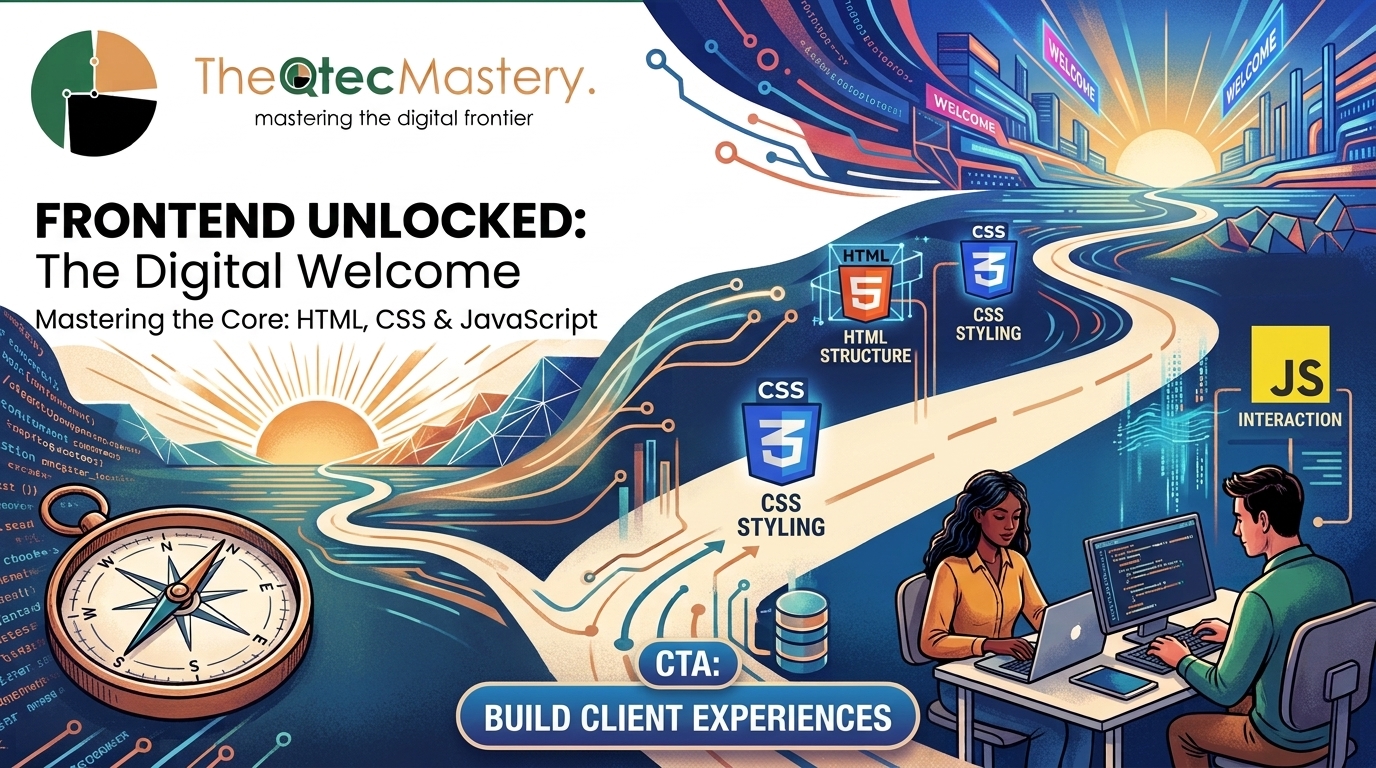

What Is Frontend Development?
A Beginner's Guide
Have you ever visited a website and thought, "Wow, this looks really good"?
Maybe the buttons respond when you click them, the page works perfectly on your phone, or everything seems to be exactly where it should be.
That experience is largely the result of frontend development.
But what exactly is frontend development, and what does a frontend developer actually do?
So, What Is Frontend Development?
Frontend development is the part of software development that focuses on what users see and interact with when they use a website or web application.
Think about your favorite website. The colors, buttons, menus, images, forms, animations, and page layouts are all part of the frontend.
But frontend development isn't just about making a website look pretty.
It's about making it functional, interactive, responsive, and easy to use.
A frontend developer takes a design or idea and turns it into something people can actually use.
What Does a Frontend Developer Do?
A frontend developer can work on things such as:
- Building website interfaces
- Creating responsive designs for phones, tablets, and computers
- Making buttons, menus, forms, and other elements interactive
- Turning UI/UX designs into working websites
- Connecting the interface to backend services
- Improving website speed and usability
- Making websites work across different browsers and devices
For example, imagine you're using an online shopping website.
You see a product, click "Add to Cart," and the item appears in your cart.
The part you see and interact with? That's where frontend development comes in.
What happens after you click that button involves the backend, which is a topic on its own.
The Three Building Blocks of Frontend Development
If you're thinking about becoming a frontend developer, you'll probably encounter three technologies very early on:
HTML: The Structure
HTML (HyperText Markup Language) provides the basic structure of a webpage.
Think of it as the skeleton of a website. It tells the browser what elements exist, headings, paragraphs, images, buttons, forms, and more.
CSS: The Appearance
CSS (Cascading Style Sheets) is what makes the website look good.
It controls things like colors, fonts, spacing, layouts, and animations.
If HTML is the skeleton, CSS is the clothing and styling.
JavaScript: The Interaction
JavaScript makes websites interactive.
It's what can make a menu open when you click it, validate a form, update information on a page, or respond to what a user does.
Put the three together and you have the foundation of modern frontend development.
What Comes After the Fundamentals?
Once you're comfortable with HTML, CSS, and JavaScript, you can start exploring tools and frameworks such as React that help developers build larger, more complex applications efficiently.
Frameworks are worth learning, but they build on top of the fundamentals rather than replacing them. A framework can change how you write code, but it can't substitute for understanding how HTML, CSS, and JavaScript actually work together.
That's why the fundamentals come first: tools will come and go, but the fundamentals will continue to matter.
Is Frontend Development Right for You?
You might enjoy frontend development if you:
- Like creating things that people can see and interact with
- Enjoy solving problems
- Have an interest in design and user experience
- Like working with technology but also enjoy the visual side of things
- Get excited when an idea in your head finally works on a screen
And you don't need to be a programming expert to start.
You can begin with simple projects, a personal webpage, a portfolio, a landing page, and gradually work your way up to more complex applications.
What's Happening Behind the Scenes?
Here's where things get interesting.
You've learned that frontend is responsible for what users see and interact with. But when you log into an account, submit information, make a purchase, or retrieve data, something else is working behind the scenes.
That's the backend.
The frontend and backend communicate with each other to make a complete application work. We'll explore exactly how that happens in the next article.
Final Thoughts
Frontend development is more than designing attractive websites. It's about creating the part of an application that people experience, interact with, and use.
With a foundation in HTML, CSS, and JavaScript, and plenty of practice, you can start turning ideas into real, interactive experiences.
And who knows? That simple webpage you build as a beginner could be the first step toward becoming a professional software developer.
Ready to start your software development journey?
Explore QTEC's Learning Opportunities